Downturned corners of the mouth and the DAO
Why the oral commissure turns down, the depressor anguli oris and its neighbours, and how diffusion here produces an asymmetric smile.
A downturned oral commissure is one of the most commonly reported perceptual complaints in the lower face, because a mouth resting with the corners below the horizontal is read by observers as sadness or disapproval regardless of the mood of the person. The presentation is usually a combination of two things: active depression of the corner by muscle, and loss of the structural support that previously held the commissure and the tissue immediately lateral to it.
Relevant anatomy
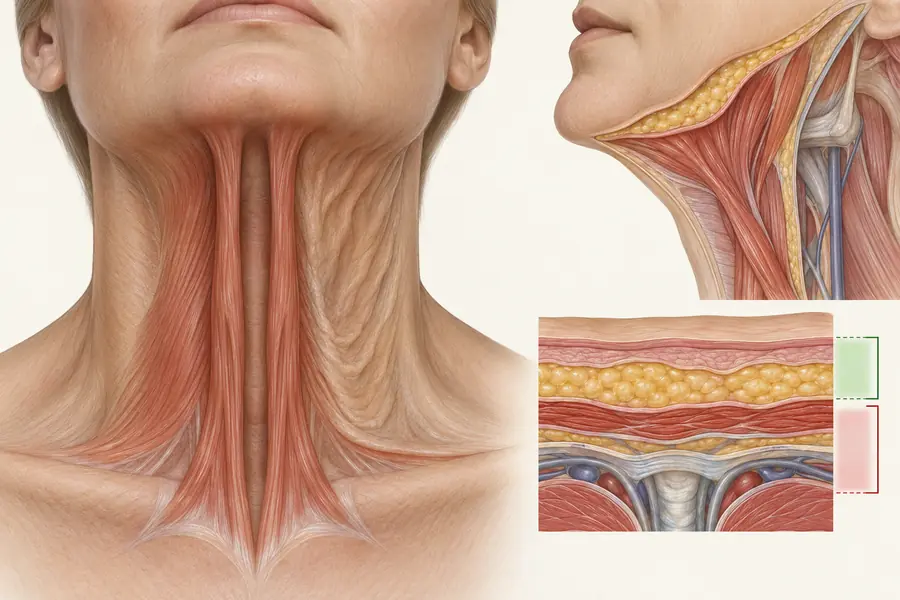
The depressor anguli oris (DAO) arises from the oblique line of the mandible and converges on the modiolus at the angle of the mouth, where it interdigitates with orbicularis oris, zygomaticus major, risorius and buccinator. Its action draws the commissure downward and laterally. Immediately medial and deep to the DAO lies the depressor labii inferioris (DLI), which arises from the mandible between the symphysis and the mental foramen and inserts into the lower lip itself. The two muscles overlap along part of their course, and the DAO is broad and thin superiorly, narrowing inferiorly, so its usable width is smallest exactly where it is most often approached.
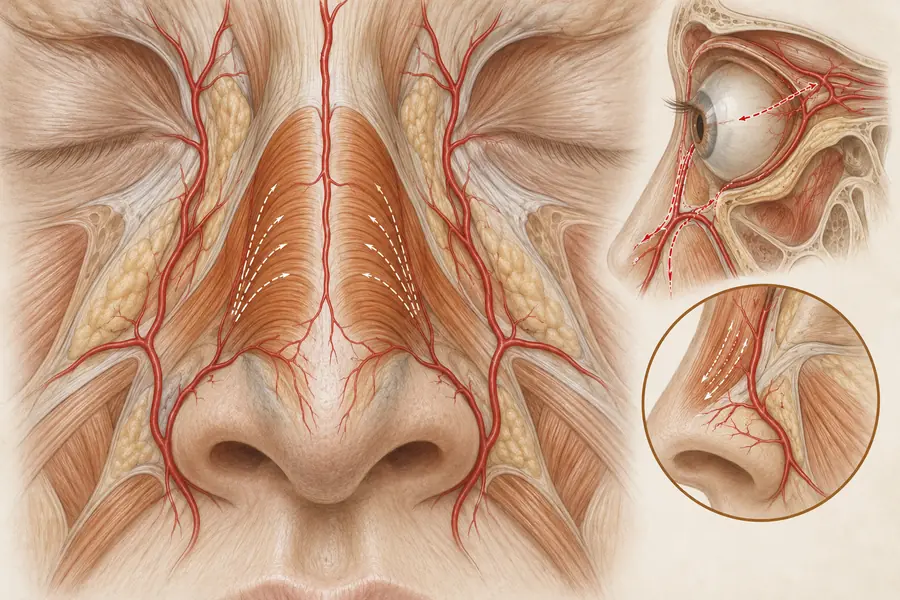
The inferior labial artery, a branch of the facial artery, runs near the vermilion border and the modiolus, and published danger zone mapping identifies the perioral region as one in which arterial course is variable and frequently superficial. The marginal mandibular branch of the facial nerve supplies both depressors and runs close to the mandibular border.
What the two approaches aim to do
Relaxation approaches target the DAO, on the reasoning that reducing its downward vector allows the antagonistic elevators — chiefly zygomaticus major and levator anguli oris — to reposition the corner. Support approaches use volumising material to restore the structural shelf lateral and inferior to the commissure, where the marionette depression forms, so that the corner is held rather than merely unopposed. In many assessments the resting position is structural while the dynamic component is muscular, and neither approach alone addresses both.
Documented risks in this region
The characteristic complication is diffusion into the depressor labii inferioris. Because the DLI depresses and everts the lower lip rather than the corner, weakening it produces a smile in which the lower lip fails to descend evenly on one side — an asymmetry far more conspicuous than the original complaint, and one that persists for the functional duration of the toxin. Further diffusion into mentalis or orbicularis oris can affect lip competence, oral continence and articulation. For filler, the perioral vascular supply and its variability mean that occlusion events are documented in this territory.
Where assessment goes wrong
Assessment fails when the DAO is not observed under animation, so that its actual width and position are inferred from surface landmarks rather than watched and palpated. It fails when commissure position at rest is attributed to muscle when the underlying problem is volume loss along the mandibular border and prejowl region. It fails again when facial asymmetry present before any intervention is not documented photographically, since minor pre-existing smile asymmetry is close to universal and is otherwise attributed to the treatment afterwards.