Hand rejuvenation using calcium hydroxylapatite
Calcium hydroxylapatite on the dorsal hand: immediate volume plus collagen stimulation, irreversibility with hyaluronidase, and nodule risk in thin mobile tissue.
Calcium hydroxylapatite (CaHA) is a semi-permanent injectable consisting of synthetic microspheres suspended in an aqueous carboxymethylcellulose carrier gel. It behaves differently from hyaluronic acid in two ways that matter for the dorsal hand: it produces both immediate volume and a delayed stimulatory response, and it cannot be dissolved.
Dual mechanism
The carrier gel provides the volume seen at the point of treatment. Over subsequent weeks the gel is resorbed and the microspheres remain, acting as a scaffold around which fibroblast activity and neocollagenesis occur. The eventual result therefore reflects the tissue response rather than the material volume, and the appearance at treatment is not the appearance that persists. This time course is a source of confusion for both practitioner and patient, because early settling can be read as failure and later stimulation as delayed overcorrection.
Relevant anatomy
The dorsal hand comprises thin, mobile skin over a superficial lamina containing the dorsal venous network and superficial radial and ulnar nerve branches, then fascia, then the extensor tendons in an intermediate lamina, with the dorsal metacarpal arteries lying deeper on the interossei. Material is intended for the superficial compartment above the tendons. Everything in this region is close to the surface, and the tissue moves substantially between finger extension and flexion.
Dilution as a concept
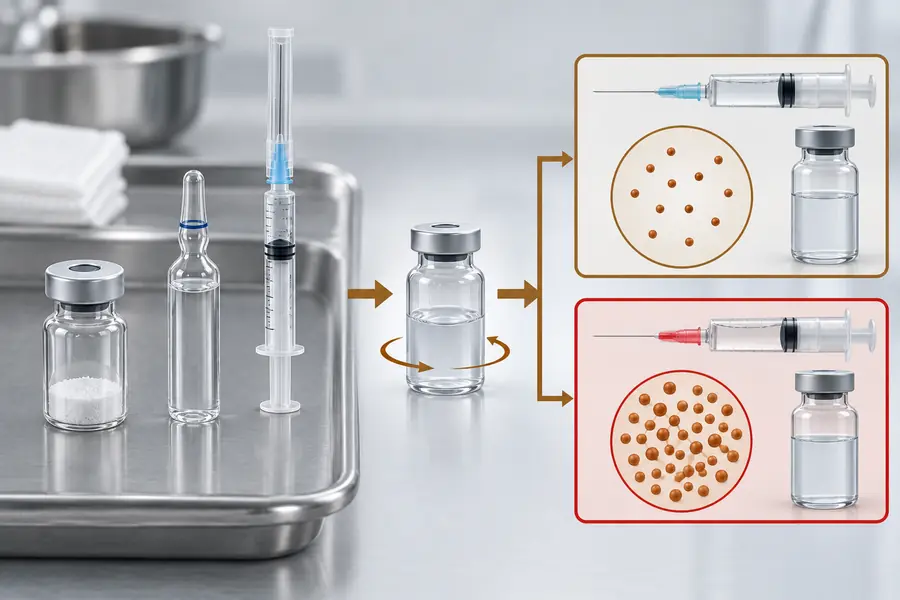
CaHA is frequently modified before use in the hand by mixing with a diluent, changing the viscosity and spread characteristics of the carrier so that it distributes across a broad, thin plane rather than remaining as a discrete deposit. The reasoning parallels the rheological literature on injectable gels, where viscosity, cohesivity and elastic modulus determine whether a material integrates within a mobile lamina or holds its shape as a bolus. Dilution is described here as a principle only; specific ratios, techniques and volumes are matters for formal training and manufacturer instructions, not for reference reading.
Irreversibility and what it implies
Hyaluronidase degrades hyaluronic acid. It has no effect on calcium hydroxylapatite. Published guidance on the management of hyaluronic acid vascular occlusion and on the safe use of hyaluronidase describes a defined emergency pathway in which suspected occlusion is treated by flooding the affected territory with enzyme. That pathway does not exist for CaHA. If material is misplaced, whether intravascularly or simply into the wrong plane, there is no antidote and no way to remove it other than time or surgical intervention. This asymmetry should inform the risk calculus before a non-reversible product is selected, particularly in a region where visibility of error is high.
Documented risks in this region
Nodules are the characteristic complication in the hand, and they are more palpable and more visible here than at most facial sites because thin skin sits directly over rigid tendons. Because CaHA is radiopaque, deposits are visible on imaging and can be mistaken for pathology if the history is unknown. Swelling, bruising and transient stiffness are reported, and the superficial venous network makes the first two common. Persistent nodularity is not resolvable enzymatically.
Where assessment goes wrong
The recurrent errors are treating CaHA as interchangeable with hyaluronic acid in planning, judging endpoint at the moment of treatment rather than allowing for resorption and stimulation, and selecting a non-reversible product for a patient whose expectations or anatomy suggest that reversal might later be wanted.