Hyperhidrosis treatment and cholinergic blockade
Why botulinum toxin affects sweat glands, how axillary and palmar treatment differ, and why grip weakness is the palmar-specific documented risk.
Primary focal hyperhidrosis is sweating in excess of thermoregulatory requirement, confined to discrete sites — most often the axillae, palms, soles and scalp — without an identifiable systemic cause. It is a functional and social problem rather than a cosmetic one, and its physiology explains why a neuromuscular agent is effective against a glandular complaint.
Relevant physiology
Eccrine sweat glands are innervated by postganglionic sympathetic fibres, but unlike most sympathetic effectors these fibres are cholinergic: they release acetylcholine onto muscarinic receptors on the glandular epithelium rather than noradrenaline. Botulinum toxin type A cleaves SNAP-25, a component of the SNARE complex required for vesicular release of acetylcholine at the presynaptic terminal. The block is therefore not specific to the neuromuscular junction; it applies to any cholinergic terminal the toxin reaches. Intradermal placement in a hyperhidrotic field interrupts acetylcholine release at the sudomotor terminals, and sweating in that field falls until terminals regenerate.
Duration in glandular tissue is often reported as longer than in skeletal muscle. The bibliometric literature on botulinum toxin records hyperhidrosis among the established indications, distinct from the aesthetic muscular applications that dominate citation counts.
Axillary versus palmar treatment
The axilla is comparatively straightforward: the hyperhidrotic field is definable, usually by a starch-iodine mapping technique, the target is intradermal, and there is no functionally important superficial musculature beneath the treated skin. Discomfort is moderate and the therapeutic margin is wide.
The palm is different in three respects. First, palmar skin is glabrous, thick and densely innervated, making percutaneous injection markedly more uncomfortable and often requiring regional or topical anaesthesia. Second, the sweat gland density is high and the field is large relative to the area. Third, and most importantly, the thenar and hypothenar eminences and the lumbricals lie immediately beneath the treated dermis. These are small muscles of the hand serving pinch, opposition and grip.
Documented risks
The palmar-specific risk is intrinsic hand muscle weakness. Diffusion beyond the dermis into thenar or lumbrical muscle produces reduced grip strength and impaired fine pinch, typically transient but lasting weeks and clinically significant for anyone whose work or instrument-playing depends on the hand. This is described consistently in the literature as the limiting adverse effect of palmar treatment and is the reason the palm is regarded as a more demanding site than the axilla.
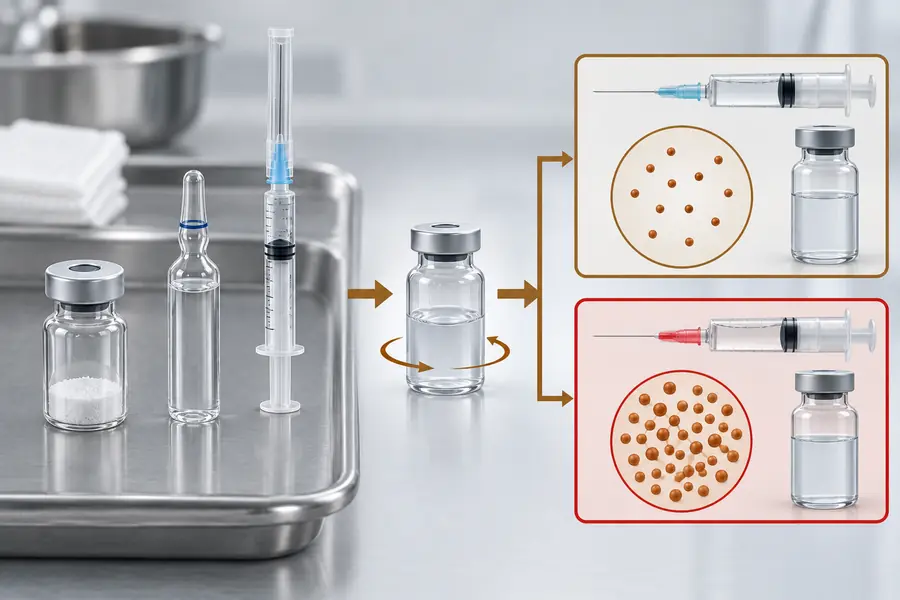
Compensatory sweating at untreated sites is reported. Dilution influences the field of diffusion from each deposit, and a more dilute preparation covers a wider area from fewer entry points at the cost of less predictable containment — relevant everywhere, but particularly where an unwanted muscular target lies close beneath.
Secondary non-response is also described. A case series across multiple sites documented patients developing resistance to botulinum toxin A after repeated exposure, with neutralising antibody formation the presumed mechanism. Because hyperhidrosis treatment often involves larger cumulative quantities and repeated cycles over many years, this is more than theoretical for this indication.
Where assessment goes wrong
Assessment fails when secondary hyperhidrosis is not excluded, since sweating driven by endocrine, neurological, infective or drug causes will not respond and the underlying condition goes uninvestigated. It fails when the affected field is assumed rather than mapped, so treatment is placed by convention rather than by observation. It fails again when the functional stakes of palmar weakness are not discussed with someone whose occupation depends on hand strength.