Nefertiti lift: the neck and jawline treatment
How platysmal pull blurs the jawline, what relaxing the platysma can achieve, and the neck-specific risks of over-treatment including dysphagia.
The Nefertiti lift is a descriptive name for a pattern of botulinum toxin placement along the upper platysma and the lower mandibular border, intended to sharpen the definition of the jawline. The name refers to the sculpted jaw of the well-known bust; the technique itself rests on a straightforward antagonist argument.
Relevant anatomy
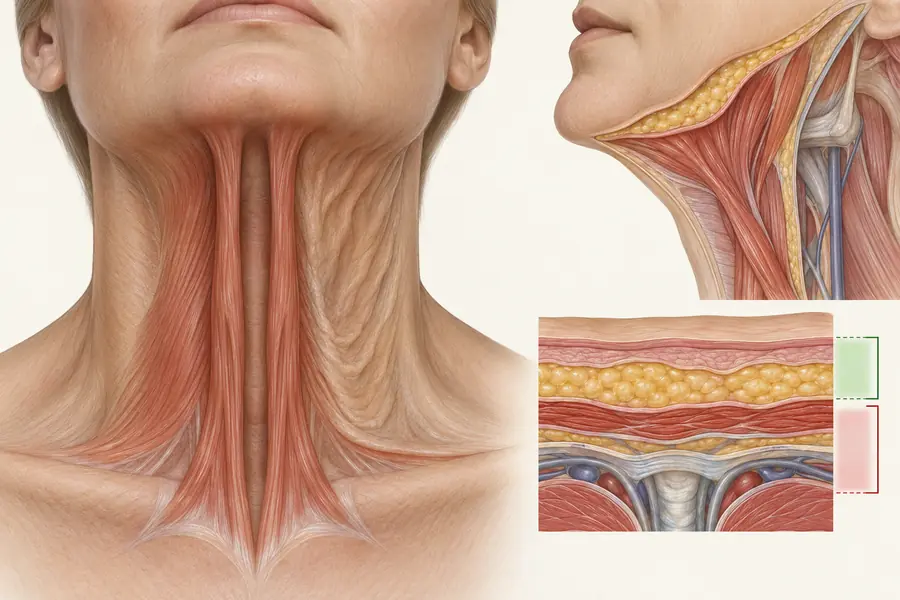
The platysma is a broad, thin sheet of muscle in the superficial cervical fascia, arising from the fascia over pectoralis major and deltoid, ascending the neck and inserting into the mandible, the modiolus, the lower lip depressors and the skin of the lower face. Its fibres decussate variably across the midline; anatomical studies describe several patterns of decussation, which is part of why banding presents so differently between individuals.
Functionally, the platysma is a depressor. It pulls the skin of the lower face and the corners of the mouth downward and tenses the neck skin. As a facial elevator complex is opposed by a broad depressor sheet, the resting vector across the jawline is downward. The marginal mandibular branch of the facial nerve supplies the lower lip depressors and runs close to the mandibular border, and the sensory territory of the cervical plexus — the transverse cervical and great auricular nerves — covers the anterolateral neck and the angle of the mandible.
What the approach aims to do
Relaxing the upper platysma removes part of the downward pull on the mandibular border and the corner of the mouth, allowing the elevators to act with less opposition. The visible effect is a jawline that appears cleaner because the soft tissue immediately below it is no longer being drawn downwards, and a slight upward repositioning of the oral commissure. This is myomodulation: altering the balance between opposing muscle groups rather than adding or removing tissue.
Limits of the effect
The limits are important and frequently understated. The technique alters muscular vector; it does nothing to submental fat, to skeletal mandibular projection, or to skin laxity. A jawline blurred by submental adiposity or by genuine dermal laxity will not be improved by relaxing muscle, and treating it as though it will produces a patient who has paid for a neck that feels weaker and looks the same. The effect is also proportional to how much platysmal tone was contributing in the first place: someone with a strong active platysma has more to gain than someone whose contour loss is structural. Effect duration follows the usual toxin course, and repeated exposure carries the possibility of secondary non-response, documented in a multi-site case series of patients who developed resistance to botulinum toxin A after repeated treatment.
Documented risks
The neck is a less forgiving field than the face. Excessive or deep placement in the anterior neck can affect the strap muscles and the pharyngeal musculature, and dysphagia is the documented consequence — difficulty initiating a swallow, or a sense of obstruction, persisting for weeks. Neck weakness, including difficulty lifting the head from supine and altered head posture, is reported when total quantity across the neck is high. Diffusion towards the mandibular border can affect the lower lip depressors and produce the asymmetric smile more usually associated with marginal mandibular injury.
Where assessment goes wrong
The dominant failure is diagnostic: attributing a contour problem to platysmal pull when the contributors are fat, bone or skin. Assessment must include palpation, observation of the platysma under voluntary contraction, and consideration of the submental compartment. Treating an inactive platysma achieves nothing while accepting all of the risk.