How to store and reconstitute Botox
Cold chain, reconstitution principles, why units are product-specific and never interchangeable, and how UK prescription-only status shapes handling.
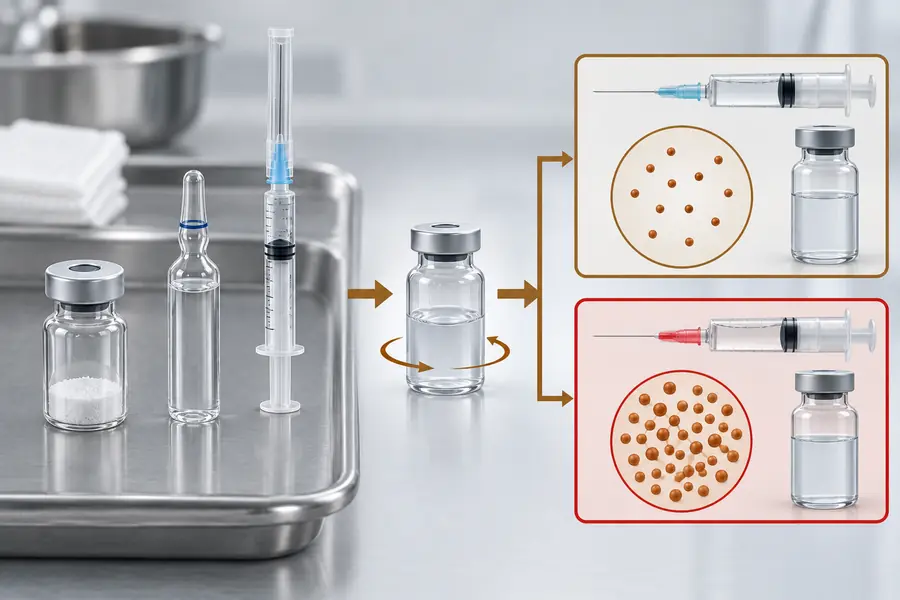
Botulinum toxin type A is supplied as a lyophilised or vacuum-dried protein complex requiring reconstitution before use. It is a biological product, and the properties that make it effective — a large, conformationally sensitive protein — are the properties that make its handling consequential.
Cold chain
Manufacturer storage specifications for the unopened vial, and for the reconstituted product, are stated in the summary of product characteristics for each individual product and differ between them. The underlying principle is that the active moiety is a protein whose activity depends on its three-dimensional structure, and that structure is degraded by heat, by freeze-thaw cycling and by mechanical agitation. A product that has been outside its specified conditions may look identical and be substantially less active, and there is no bedside test for potency. The practical implications are unglamorous: monitored, dedicated refrigeration with a recorded temperature log; documented handling of any excursion; awareness that transport and delivery are part of the chain and not exempt from it; and a stock system that respects expiry.
Reconstitution principles
Reconstitution introduces two considerations. The first is mechanical: the toxin complex is sensitive to shear, and vigorous handling during reconstitution is discouraged for that reason. The second is the relationship between dilution and diffusion. The number of units delivered is set by the quantity of toxin; the volume in which those units are carried determines how far the material spreads from each deposit. A more dilute preparation covers a wider field from fewer entry points; a more concentrated one confines its effect to a smaller area. Neither is correct in the abstract. The right choice depends on whether the target is a broad sheet of muscle where even coverage is wanted, or a small muscle with a functionally important neighbour close by, where containment matters more than reach. This is a principle only — specific dilutions, volumes and placements belong to formal training and to the manufacturer’s instructions, not to reference reading.
Units are product-specific
This is the point at which errors are most dangerous, and it is worth stating without qualification: units of botulinum toxin are not a standardised measure. Each product’s unit is defined by its own manufacturer’s proprietary assay, using its own methods and reference standards. Units of one product are not equivalent to units of another, and no fixed conversion ratio between brands is endorsed by the manufacturers. Quantities are therefore only meaningful when named alongside the specific product, records must state which product was used, and a patient reporting “the same amount as last time” has given no usable information without the brand.
Repeated exposure also matters clinically. A multi-site case series documented patients developing resistance to botulinum toxin A after repeated cosmetic treatment, presenting as progressive loss of response despite unchanged handling, with neutralising antibody formation the presumed mechanism. Cumulative exposure and treatment frequency are therefore part of the record, not incidental detail.
UK regulatory position
In the United Kingdom, botulinum toxin products are prescription-only medicines. That status determines how they may be obtained, who may prescribe them, that a prescription must follow an appropriate assessment of an identified individual, and how they may be held on premises. It also restricts advertising: prescription-only medicines may not be promoted to the public, which is why the brand names are conspicuously absent from compliant public-facing material and why generic descriptions are used instead. These are legal constraints on handling and communication, distinct from questions of clinical technique.