Biostimulation versus volumising: reference notes
How collagen-stimulating injectables differ from volumising fillers in mechanism, onset and endpoint, and an honest account of what the evidence establishes.
Injectables are frequently grouped together as “fillers”, which obscures a division that matters more than any brand distinction: whether the product supplies the volume itself, or whether it provokes the tissue into producing volume.
Two different propositions
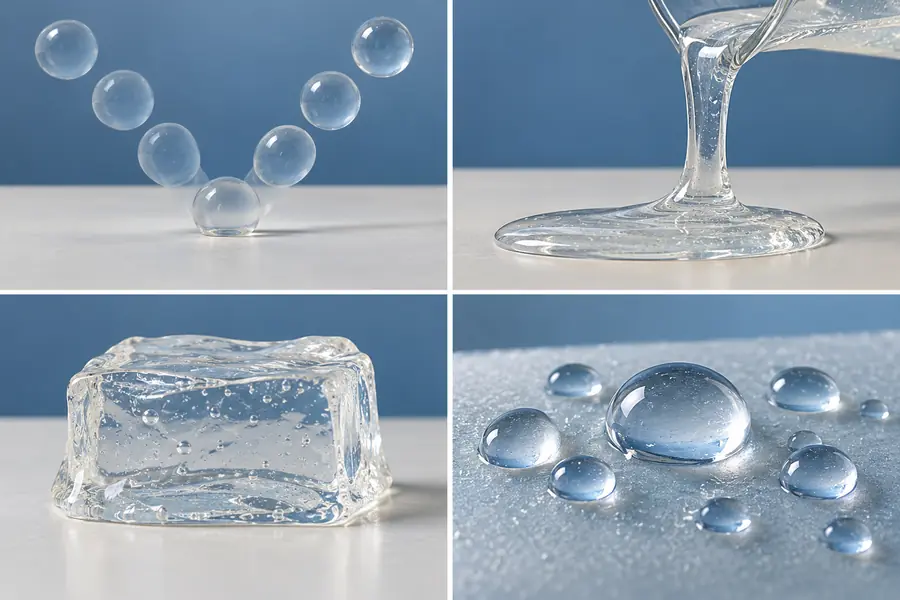
A volumising hyaluronic acid gel occupies space. Its behaviour is described by measurable physical properties — elastic modulus, viscosity, cohesivity, water binding — and the result is visible at the end of the appointment. Because the material is the result, the result is adjustable during treatment and reversible afterwards.
A collagen biostimulator works differently. Particulate products such as poly-L-lactic acid and calcium hydroxylapatite are carried in a gel or suspension that is itself temporary. What persists is the tissue response to the particles. Published mechanistic reviews describe a controlled, low-grade foreign body response: monocyte and macrophage recruitment, a shift towards a reparative macrophage phenotype, fibroblast activation, and upregulation of type I and type III collagen and elastin over subsequent months. Morphological studies show that particle shape, size and surface differ between products, and that these differences shape the character of the response.
Consequences of that difference
Onset is slow. Any immediate change after biostimulator injection reflects the carrier and the injection oedema, not the outcome. The actual endpoint develops over weeks to months, which is why sequential sessions appear in the literature with intervals between them rather than a single-visit endpoint.
The endpoint is variable. The result is produced by the patient’s own fibroblast response. Age, skin condition and individual variation all influence it, and the same volume of the same product does not produce the same change in two people. Studies reporting age-related trends in biostimulatory response exist precisely because the response is biological rather than mechanical.
It is not readily reversible. There is no enzyme equivalent to hyaluronidase for a collagen response or for a non-hyaluronic particulate. Misplacement, over-correction or nodule formation must be managed rather than dissolved, which changes the risk calculation for superficial placement and for mobile or thin-skinned regions.
The complication profile differs. Biostimulators carry their own reported adverse events, including delayed nodules and papules. Systematic review work in this area is ongoing and is explicitly framed around establishing the proportion of such events rather than assuming it is already known.
An honest note on evidence quality
The mechanistic literature is reasonably coherent: histology and cytokine work supports neocollagenesis as a real phenomenon rather than marketing language. The clinical literature is weaker. Much of it consists of case series, expert consensus documents and manufacturer-linked studies rather than adequately powered independent comparisons with blinded assessment and long follow-up. Systematic review protocols in this field are still being written, which is itself an indication that the pooled adverse event picture has not yet been established.
That is not an argument against these products. It is an argument against presenting their outcomes with the confidence appropriate to a measured volumising gel. The rheological data that make hyaluronic acid behaviour reasonably predictable have no equivalent here, because the variable being predicted is a biological response rather than a material property. Anything presented to a patient as a defined result at a defined date is being presented with more certainty than the underlying evidence supports.