Hyaluronidase protocol: dilution and administration
Reference notes on why published reversal protocols emphasise concentration and territory rather than volume, and why no reliable conversion to filler volume exists.
This is a reading note on how hyaluronidase is described in the published literature. It is not a protocol to follow, and nothing here substitutes for the guidelines themselves, for training, or for a clinician’s own judgement in an emergency.
The variable that matters
Hyaluronidase acts on hyaluronic acid by hydrolysis, at the site of contact. It does not circulate to find the material. Every feature of the published emergency protocols follows from that single fact: the enzyme must physically reach the gel, at sufficient concentration, for long enough to degrade it.
Dilution is therefore not a matter of convenience. The reconstitution volume determines concentration, and concentration determines how much enzyme activity is present in the tissue the solution actually reaches. Published high-dose pulsed protocols describe reconstitution in the order of 1500 units in 1 mL — a deliberately concentrated preparation, in contrast to the larger dilutions used for elective dissolution of a well-placed but unwanted result, where the objective is controlled and gradual degradation rather than urgent clearance.
The two situations are not variations of one technique. Elective dissolution is a cosmetic correction with time available. Emergency reversal of a vascular occlusion is time-critical tissue rescue, and the parameters differ accordingly.
Territory rather than entry point
The second recurring theme in the literature is anatomical. An occluding plug does not necessarily remain where the needle was. It sits somewhere within a vascular territory, and its precise position is unknown at the moment of treatment.
Published protocols consequently describe flooding the affected vascular territory — the region supplied by the vessel, defined by anatomy and by the distribution of the clinical signs — rather than concentrating treatment at the original injection site. The vessel is the target, the territory is where it can be reached, and treating only the entry point risks leaving the plug untouched.
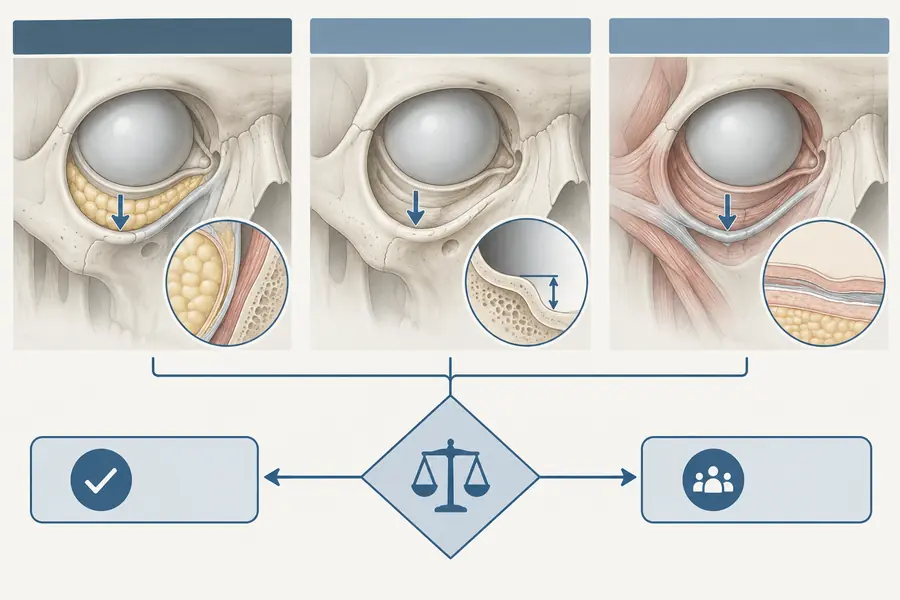
Where the orbit is involved the anatomy is different again, and separate anatomical work addresses retrobulbar administration specifically. That is a distinct procedure with its own anatomical constraints, described in its own literature, and it is not an extension of facial technique.
Repetition to a clinical endpoint
The word “pulsed” describes the third theme. A single administration produces a brief peak of enzyme activity that decays, often before the plug has been meaningfully degraded. Published protocols describe repeated administration at intervals, continued until clinical resolution — returning capillary refill, resolving mottling and dusky discolouration, relief of the characteristic pain — rather than until a predetermined total has been given.
The endpoint is therefore clinical, not numerical. Systematic review work in this area describes substantial cumulative quantities across the reported cases, which is a direct consequence of treating to resolution.
No conversion factor
A recurring question is how many units are needed per millilitre of filler. There is no reliable answer, and the literature does not supply one. Enzyme requirement varies with the product’s cross-linking and concentration, with the volume and location of the deposit, with how long it has been in place, and with the enzyme preparation itself. Any published figure is an approximation from a specific set of circumstances rather than a rule.
Late presentation
Delay worsens the prognosis but does not abolish the case for treatment. Reports describe meaningful recovery after intervention begun considerably later than the ideal window, including forehead and nasal cases with established skin compromise. The practical implication is that a patient presenting late is still a patient to treat, not a patient to observe.
On finding the protocol as a document
The published guidance is frequently looked for as a downloadable PDF. The authoritative versions are the guidelines themselves, linked at the foot of this page — they are the documents worth having, rather than a summary slide circulating between practitioners. This page is a reading note on what they contain, not a substitute for them, and it is deliberately kept as a web page so it can be corrected when the guidance is revised.