Skin lesions in aesthetic assessment and when to refer
Why practitioners working on the face must be able to recognise when a lesion belongs to a referral pathway rather than to a treatment plan.
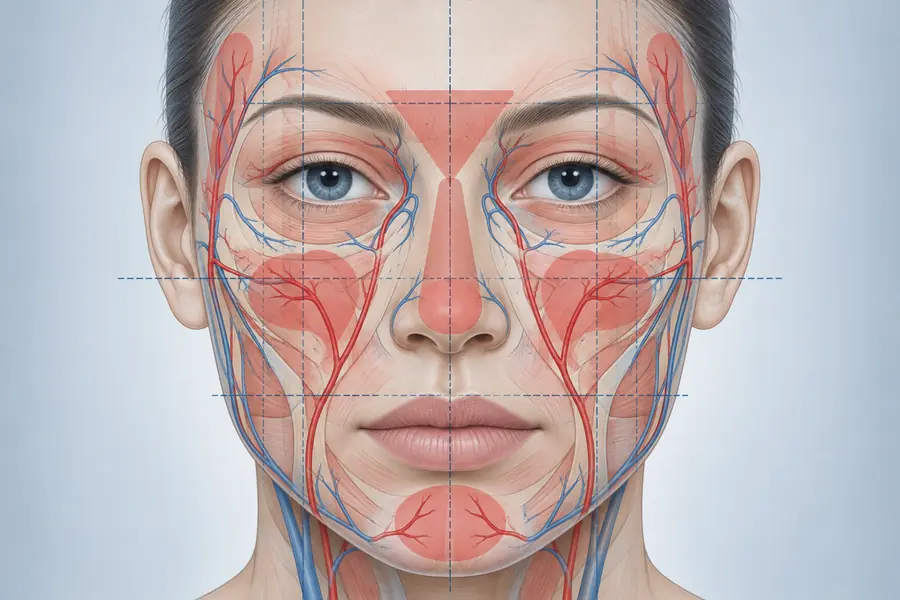
Aesthetic practice involves looking closely at facial skin, in good light, repeatedly, over years. That is an unusual degree of access, and it means practitioners encounter lesions that the patient has not noticed and has not mentioned to anyone else.
This page does not set out diagnostic criteria, and it is not a guide to identifying skin cancer. Its subject is narrower and more useful: the obligation to recognise the boundary of one’s own scope, and to route anything that falls outside it to someone qualified to assess it.
What the assessment actually is
An aesthetic consultation is not a skin check, and presenting it as one would be misleading. But a treatment plan requires an examination of the skin being treated, and that examination will sometimes reveal something unrelated to the reason for attendance.
The realistic categories are three. Most lesions are benign and well known — seborrhoeic keratoses, dermatosis papulosa nigra, milia, benign naevi, sebaceous hyperplasia, telangiectasia, solar lentigines. Some are markers of chronic sun exposure that sit in a field of change rather than being discrete problems, actinic keratoses being the common example. And a small number are lesions whose appearance, history or behaviour means they need an opinion from a clinician who assesses skin lesions as their work.
The classification that matters in the room is not diagnostic. It is: does this belong in a treatment plan, or does it belong in a referral?
Features that move a lesion out of scope
Without functioning as diagnostic criteria, several general observations should end the treatment conversation and start a referral one. Change reported by the patient — in size, shape, colour, sensation or surface — is the most important, because change is historical information no photograph provides. So is a lesion that bleeds, ulcerates, crusts repeatedly or fails to heal. So is any lesion the practitioner cannot confidently place in a familiar benign category.
The last of these is the one most often overlooked. Uncertainty is itself the finding. A lesion that does not look like anything recognised is a reason to refer, not a reason to look again next time.
Where the formal thresholds live
In the United Kingdom the referral thresholds for suspected skin cancer are set out in NICE guidance on the recognition and referral of suspected cancer, with a quality standard covering timeliness of suspected cancer pathway referrals. Those documents are written for the clinicians who make the referral decision, and they are where the criteria properly belong.
The point of citing them here is not to summarise them. It is that a defined national pathway exists, that it operates on urgency thresholds, and that a delay introduced by a non-referral in an aesthetic setting is a delay in that pathway.
Practical consequences
Three follow. First, record what is seen. A dated note and photograph of a lesion observed at consultation is clinically and professionally valuable regardless of what happens next.
Second, do not treat over uncertainty. Injecting, resurfacing or applying energy in the vicinity of an unassessed lesion risks altering its appearance, delaying assessment, and complicating the history for whoever eventually examines it.
Third, refer plainly and without diagnosing. The message to the patient — this needs to be looked at by someone who assesses skin lesions, and here is how that happens — is complete in itself. It requires no diagnosis, and offering one is a step beyond the scope that made the observation worth acting on.