Cervical plexus
The network formed by the anterior rami of C1–C4, whose superficial sensory branches supply the skin of the neck, angle of the jaw and the area behind the ear.
The cervical plexus arises from the anterior rami of the first four cervical nerves and divides into a deep motor part and a superficial sensory part.
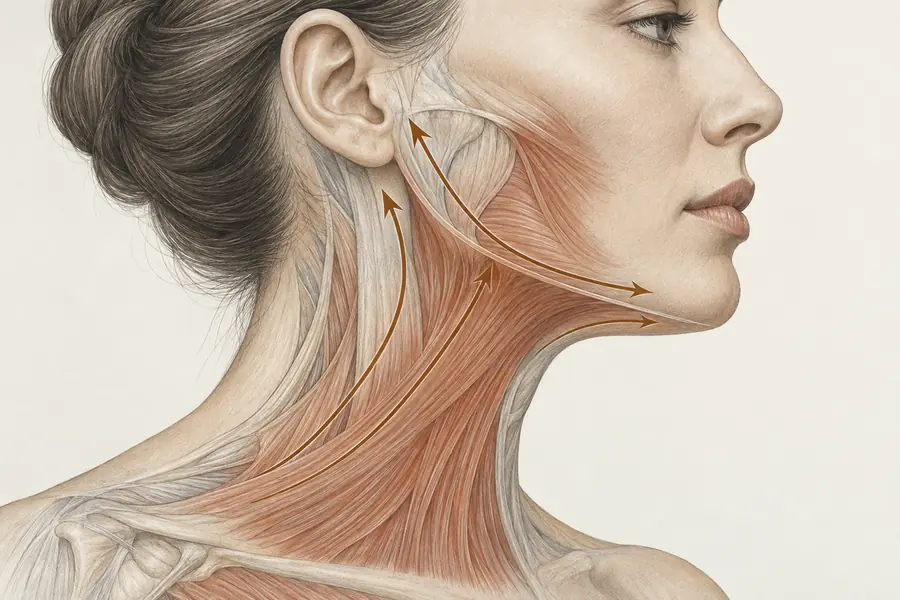
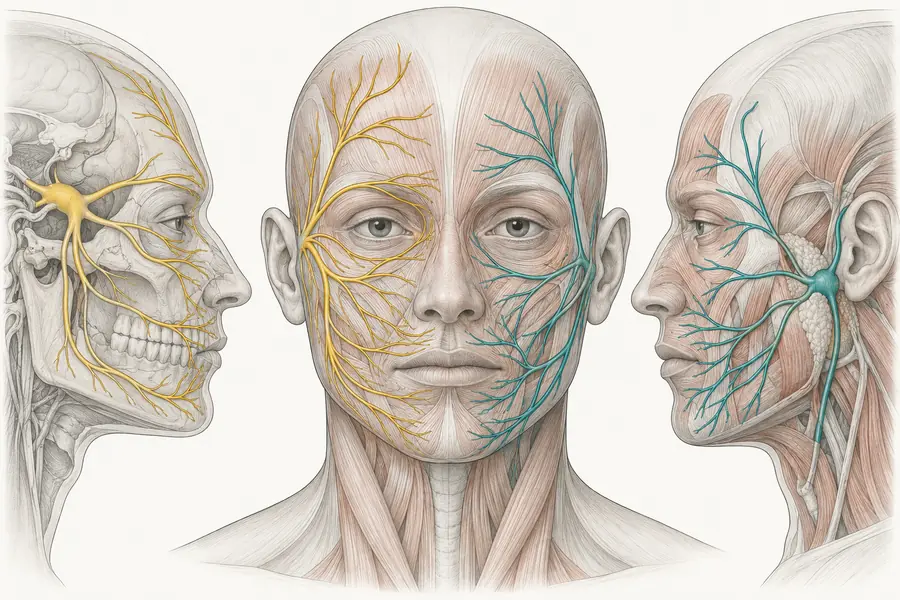
The superficial branches matter for aesthetic practice on the neck and lower face. They emerge around the midpoint of the posterior border of sternocleidomastoid — the point sometimes called the nerve point of the neck — and fan out as four named nerves: the lesser occipital (scalp behind the ear), the great auricular (ear and angle of jaw), the transverse cervical (anterior neck skin) and the supraclavicular nerves (over the clavicle and upper chest).
Two practical consequences follow. First, the sensory territory of the lower face is not all trigeminal: the skin over the mandibular angle is great auricular territory, so numbness there after a procedure points to a different nerve than a practitioner expecting only trigeminal distribution might assume. Second, the great auricular nerve runs superficially across sternocleidomastoid with very little soft tissue over it, which makes it vulnerable during work in that region.
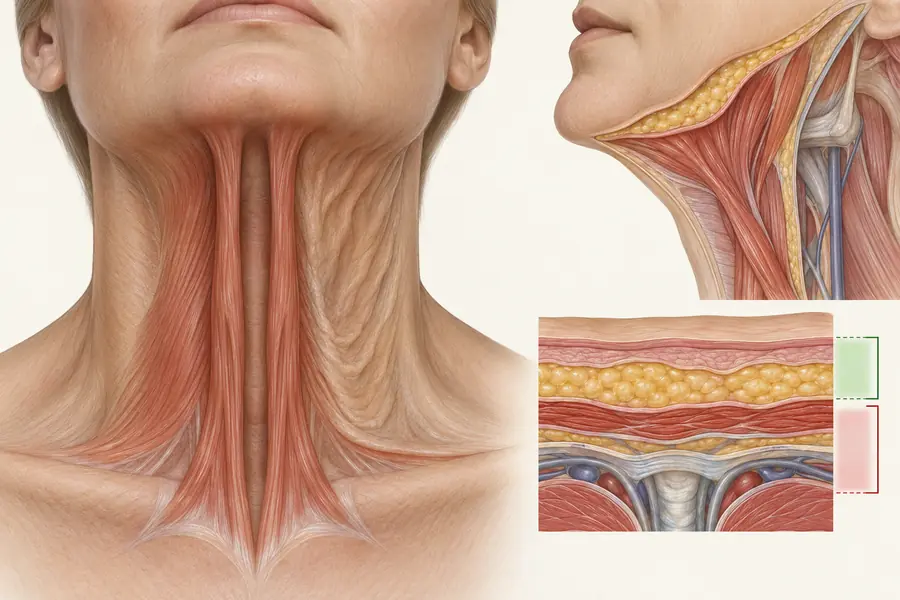
The deep branches are motor and include the contribution to the phrenic nerve — a reminder that the neck is not a region where depth can be treated casually.