Hand rejuvenation
Restoration of dorsal hand volume, where subcutaneous fat loss exposes tendons, veins and metacarpals — a region with thin skin, mobile tissue and low tolerance for overcorrection.
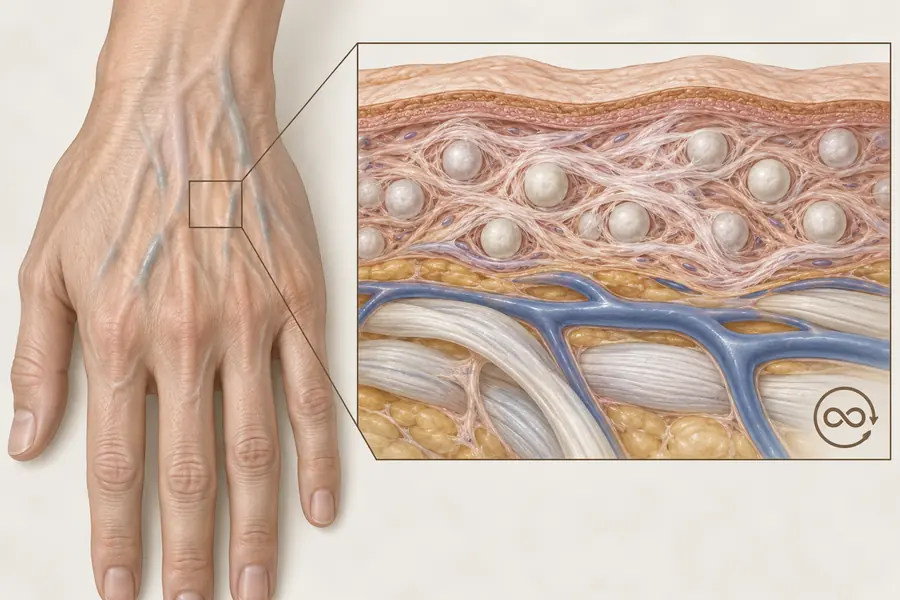
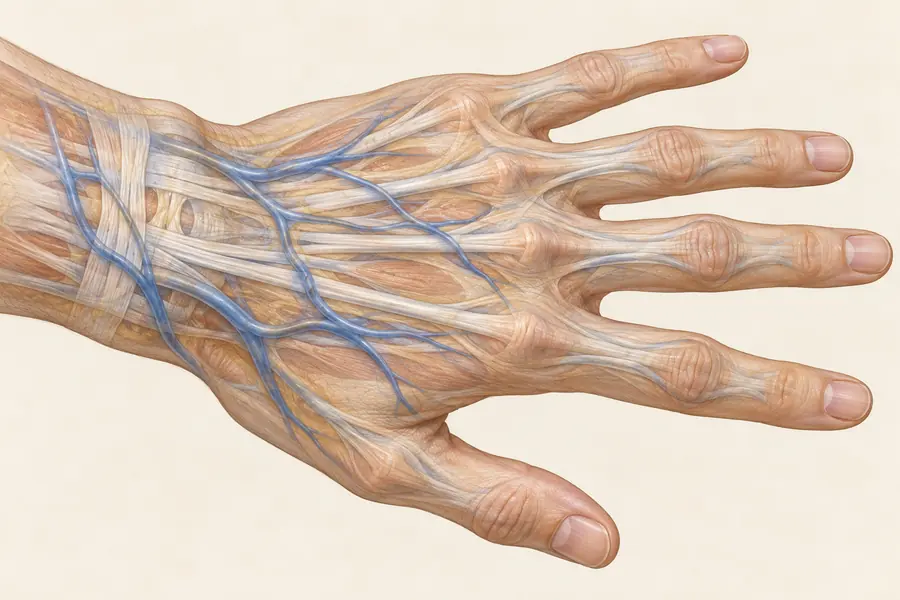
The dorsum of the hand ages primarily by volume loss. The dorsal subcutaneous layer thins, and the structures beneath it — extensor tendons, dorsal veins, the metacarpals and intermetacarpal spaces — become progressively more visible.
Anatomically the region is unforgiving. The skin is thin and glabrous, there is minimal soft tissue to conceal irregularity, and everything moves: tendons glide beneath the injection plane with every finger movement, and the dorsal venous network sits immediately subdermal.
The plane used is the dorsal superficial lamina, above the tendons and veins. Products used include crosslinked hyaluronic acid and calcium hydroxylapatite, the latter often diluted. Technique tends toward a small number of entry points with fanning or bolus placement followed by moulding, rather than multiple punctures through fragile skin.
The characteristic failure is overcorrection. A hand that is fuller than the forearm reads as swollen rather than youthful, and the visual reference is immediately available to anyone looking. Undercorrection with a second session is the safer trajectory, and hands are one of the regions where the literature most consistently recommends staging.