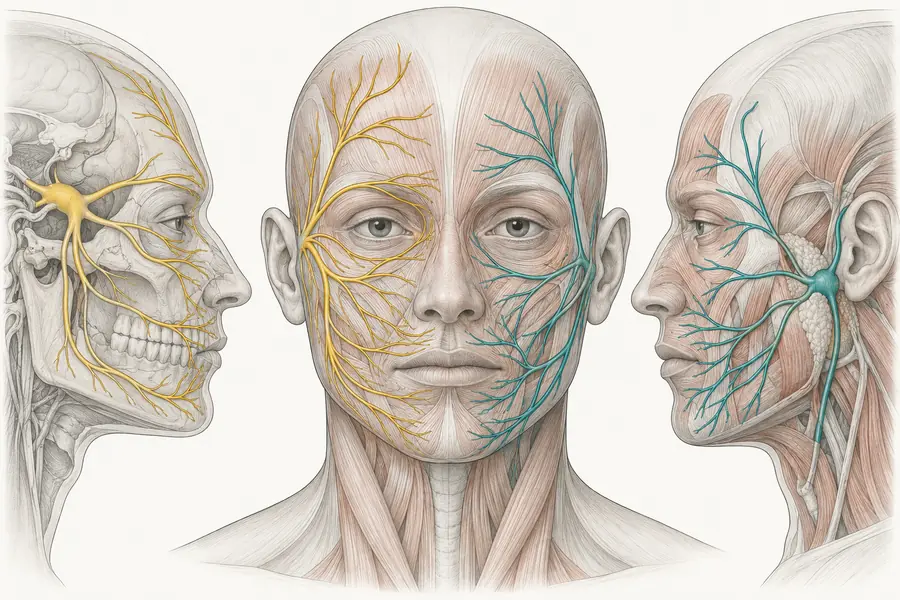
Trigeminal nerve
The fifth cranial nerve — sensory to the face through its ophthalmic, maxillary and mandibular divisions, and motor to the muscles of mastication.
The trigeminal nerve (cranial nerve V) provides almost all facial sensation and the motor supply to the muscles of mastication. It divides into three.
V1, ophthalmic. Forehead, upper eyelid, nasal dorsum, cornea. Emerges via the supraorbital and supratrochlear nerves at the superior orbital rim. Its corneal component is why anaesthesia in this territory is not a trivial finding.
V2, maxillary. Lower eyelid, cheek, lateral nose, upper lip, upper teeth. Emerges at the infraorbital foramen, roughly a centimetre below the inferior orbital rim in the mid-pupillary line.
V3, mandibular. Lower lip, chin, jaw, part of the ear and the anterior tongue; motor to masseter, temporalis and the pterygoids. Emerges at the mental foramen. Because it is the only division with a motor component, masseter treatment interacts with V3 territory.
Note what is not trigeminal: the skin over the mandibular angle belongs to the great auricular nerve from the cervical plexus. Numbness there after lower-face work has a different explanation than a practitioner assuming pure trigeminal distribution would reach for.
Facial movement is cranial nerve VII, not V — a distinction worth keeping clear when interpreting post-treatment weakness.